
The market is arguing about the wrong variable. Almost every question on Fair Isaac’s July 29 earnings call circled the same worry: will VantageScore 4.0 take mortgage scoring volume away from FICO now that the Federal Housing Finance Agency permits it inside the Fannie Mae and Freddie Mac channel? Management’s answer was credible and probably correct. Lenders are pulling both scores and shopping between them, so FICO’s units hold.
The exposure is price. Fair Isaac took its mortgage wholesale royalty from $4.95 to $10.00 per score for 2026, and that single decision now carries $1.13 billion of annualized revenue at something close to a 95% incremental margin. A United States senator has referred the pricing to the Federal Trade Commission. The FHFA director has publicly asked the company to cut that price to $0.99. The rate card resets every January.
Three things get blurred together in this argument, and they need separating. The scoring franchise. The mortgage line that now carries most of it. And the price of the stock, which is the only one of the three that has moved much in the past month. Each is answered below, in that order.
The Three Questions
The franchise: how durable is it outside mortgage? Very. Auto origination scores grew 15% this quarter and card scores 9%, on a mix of price and volume, with no government lever available to a challenger in either. Roughly $472 million of annualized revenue that nobody is contesting.
The mortgage line: how much of the company is it? 62% of Scores revenue and 41.8% of the total, earned at close to a 95% incremental margin. That concentration is larger than most published work on FICO assumes, and the threat to it runs through price rather than share.
The price: does it compensate? Not yet. At $1,045.46 the market prices roughly 11% owner-earnings growth, which the base case supports almost exactly. Fair value is where the stock sits. Fair value carries no cushion against a bear case worth $499.
The Business
What Fair Isaac Actually Sells
Two businesses share one ticker, and they could hardly be less alike.
The Scores segment licenses the FICO Score, the consumer credit risk measure that has been the American lending standard for more than three decades. Fair Isaac does not sell it to lenders. It sells the algorithm’s output to the three national credit bureaus, Equifax, Experian, and TransUnion, which package the score with their own credit file data and resell the bundle to lenders. Fair Isaac collects a royalty per score. The bureaus and their tri-merge resellers keep everything above that royalty. This is why the company can say with a straight face that it does not set the price a borrower pays for a credit report, and why the borrower’s cost has nevertheless risen so sharply.
Then look at the economics. Scores generated $458.9 million of revenue in the June quarter against $42.0 million of segment operating expense, a 91% operating margin. There is no manufacturing, no distribution, no inventory. The algorithm was built decades ago and is refreshed periodically. Every incremental score sold is close to pure margin.
Within Scores, the business-to-business side reached $400 million in the quarter and the consumer side, mostly myFICO.com subscriptions and royalties on scores distributed to consumers through the bureaus, contributed $59 million. Business-to-consumer revenue grew 5%. It is small, steady, and analytically uninteresting.
The Software segment is a different company
FICO Platform is a decisioning system that banks, insurers, and telecom operators use to run originations, fraud detection, and customer management. It competes. SAS, Experian, Provenir, and internal build teams all show up in the same deals, and the segment earns a 26% operating margin against the Scores segment’s 91%.
The quarter contained a genuine milestone. Platform annual recurring revenue reached $413 million, up 62%, and passed non-platform ARR for the first time in the company’s history. Platform dollar-based net retention was 148%. Total software ARR of $816 million grew 10%, held back by a 17% decline in the legacy non-platform book as customers migrate and older products are retired. Trailing twelve-month bookings of new annual contract value reached $128 million, up 39%.
Reported software revenue grew 2%. That number understates what is happening underneath, because point-in-time license revenue from legacy renewals is falling away while recurring platform revenue compounds. Chief Executive Will Lansing described the company as historically “IP rich and distribution poor,” and in July expanded a partnership with Accenture aimed squarely at that problem. Normalizing for point-in-time and professional services revenue, the segment grew 10%.
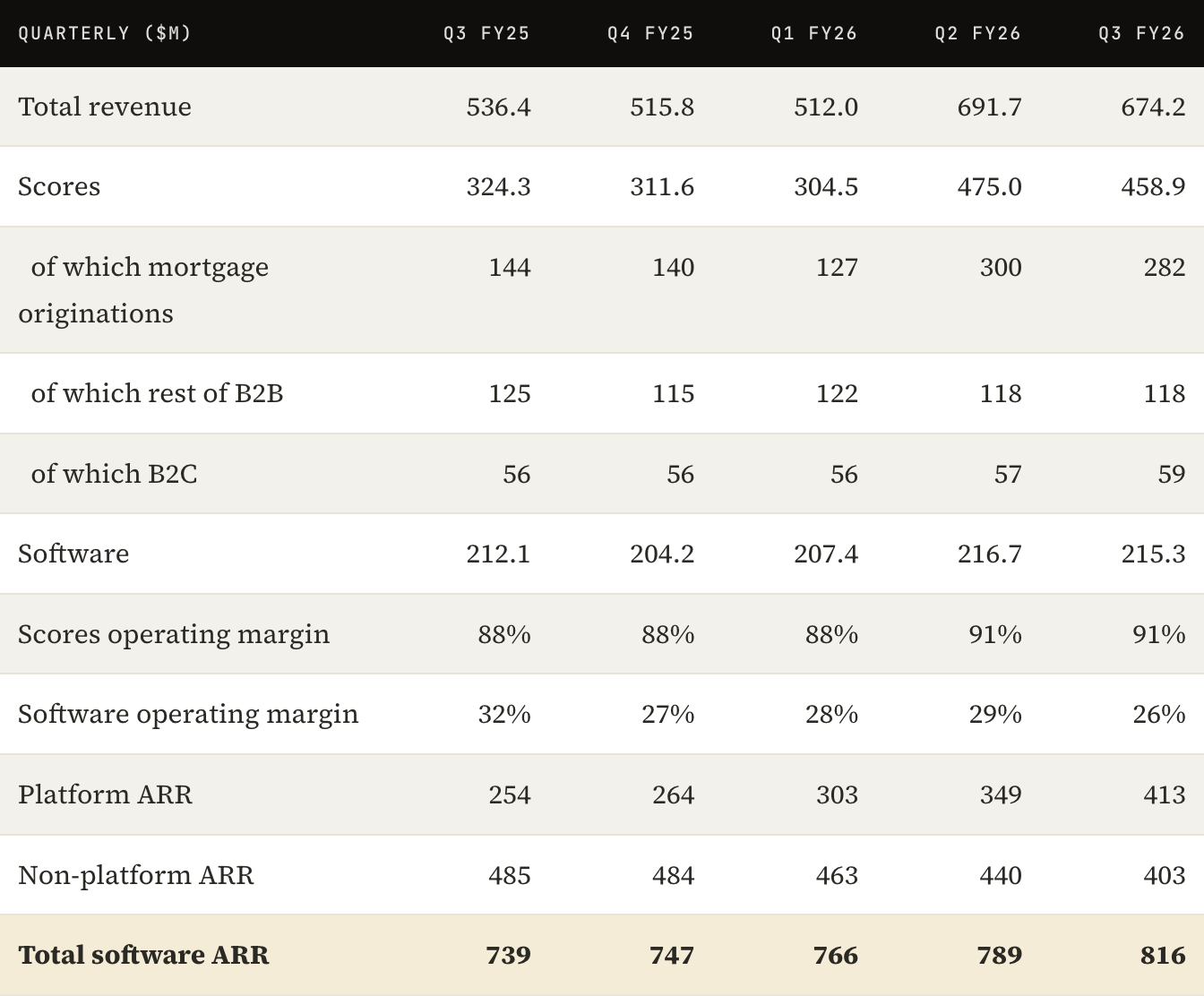
Source: FICO Q3 FY2026 investor presentation, pages 6, 18, 20, 28.
Moat
