
Dear readers,
Welcome back to the Quality Equities newsletter.
Every quarter, institutional investment managers overseeing at least $100 million in assets must file a 13F report with the US Securities and Exchange Commission (SEC), offering a snapshot of their equity holdings at quarter-end.
I always look forward to reviewing the latest 13F filings, as they provide valuable insight into how top investors (e.g., Warren Buffett’s Berkshire Hathaway, Bill Ackman’s Pershing Square, Dev Kantesaria’s Valley Forge Capital Management, etc.) are allocating capital.
In the most recent filings, one of my all-time favorite investors, Dev Kantesaria, revealed that his fund, Valley Forge Capital Management, initiated a position in MSCI 0.00%↑ MSCI, a company that has been on my watchlist for quite some time. Although specific details about his investment in MSCI are not publicly disclosed, the company's business model strongly aligns with Kantesaria's investment criteria. He prioritizes companies with durable competitive advantages and efficient capital allocation, qualities that MSCI exemplifies.
In today’s article, we’ll dive into MSCI’s business model and evaluate its current valuation to determine whether it presents a compelling investment opportunity for your portfolio.
MSCI’s Business Model
MSCI operates a subscription-based, highly scalable business model that provides investment decision support tools to institutional investors, including asset managers, hedge funds, banks, and pension funds. The company generates revenue primarily through recurring subscriptions and licensing fees, making its business highly predictable and resilient. Recurring revenue makes up more than 90% of annual revenues.
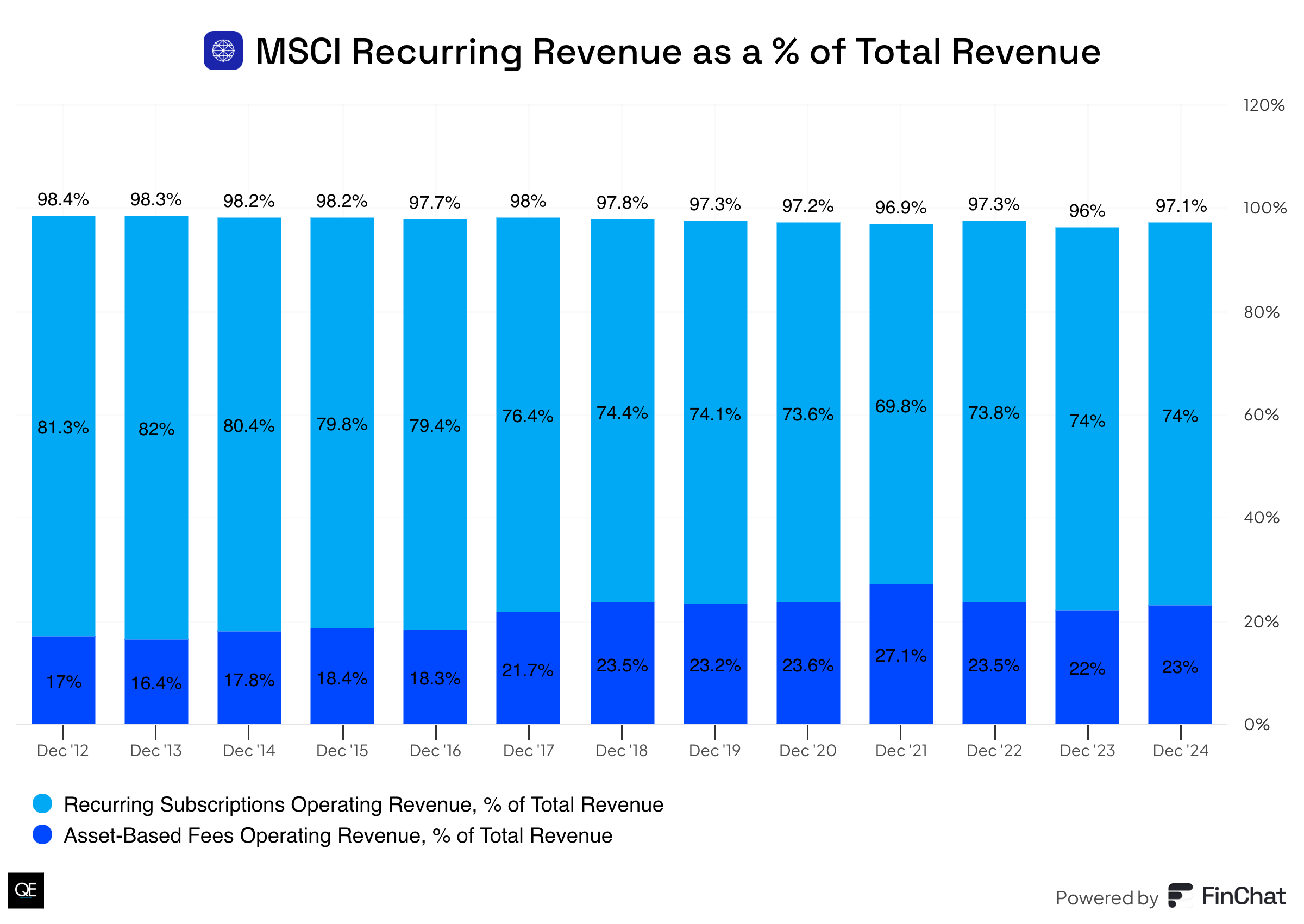
MSCI’s services are essential for investors who need benchmark indices, risk management tools, and ESG analytics to inform their investment strategies. As a financial data powerhouse, MSCI benefits from the continued growth of passive investing, increasing demand for ESG integration, and the expanding role of data-driven investment decisions.
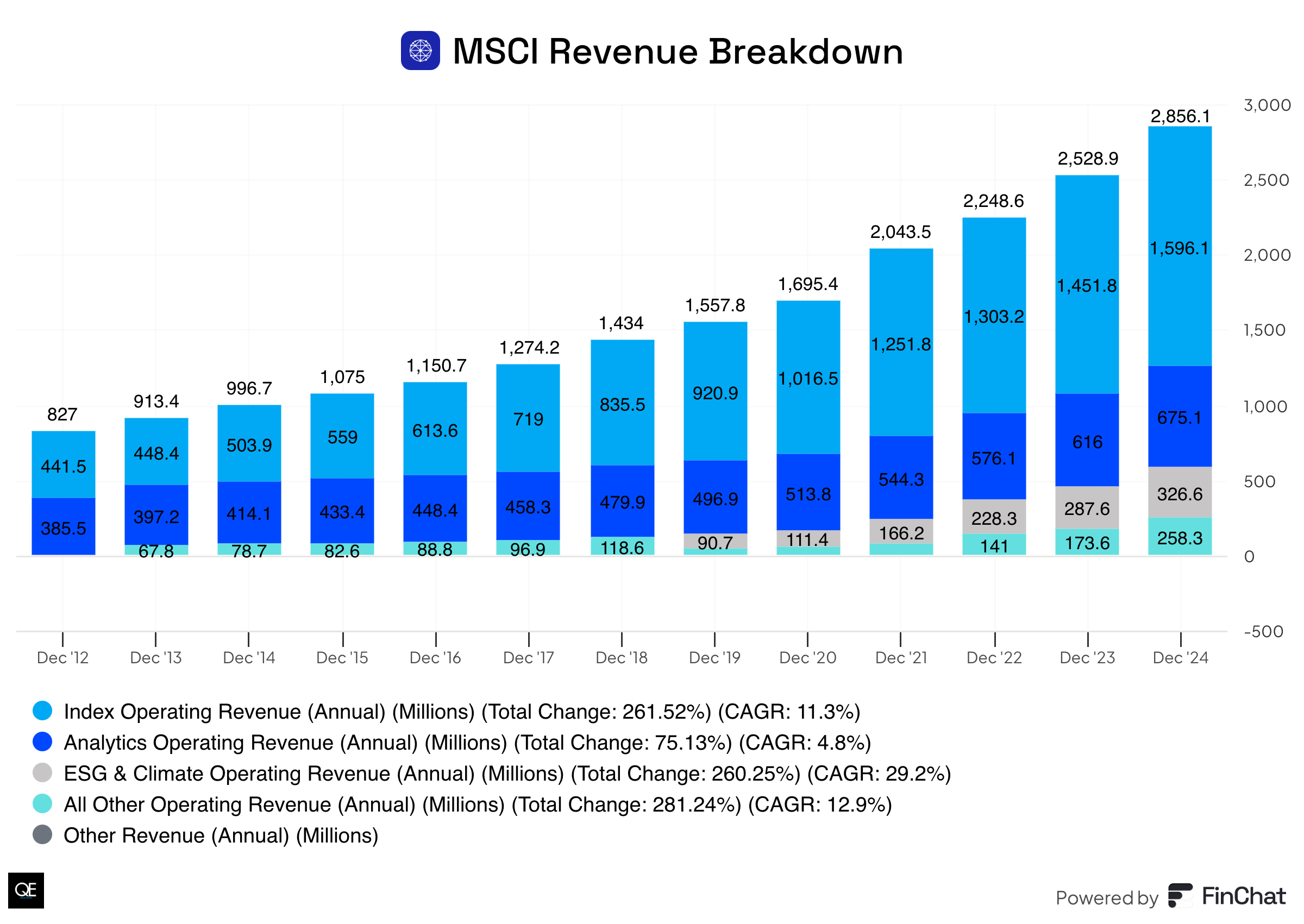
The Index segment is MSCI’s largest revenue driver, contributing significantly to the company’s earnings. MSCI’s indices, such as the MSCI World, MSCI Emerging Markets, and MSCI ACWI, are widely used as benchmarks for ETFs, mutual funds, and passive investment products. The company earns revenue by licensing these indices to ETF issuers (such as BlackRock’s iShares) and asset managers who track MSCI benchmarks. In addition, institutional investors pay for subscription-based access to index data, allowing them to analyze market trends and construct portfolios. MSCI also develops custom indices for clients who require specialized benchmarks, further strengthening its pricing power and competitive moat.
Beyond indices, MSCI’s Analytics segment provides sophisticated risk management and performance analytics tools. The company’s RiskMetrics platform helps investors measure and manage portfolio risk, while its Barra factor models enable quantitative analysis of investment strategies. Institutional clients subscribe to MSCI’s analytics to assess portfolio exposures, optimize asset allocation, and comply with regulatory requirements. With financial markets becoming more complex and data-driven, demand for advanced analytics continues to grow, making this segment a key pillar of MSCI’s long-term expansion.
A fast-growing area of MSCI’s business is its ESG & Climate segment, which capitalizes on the increasing emphasis on sustainability in investment decision-making. MSCI provides ESG ratings and research to institutional investors seeking to integrate environmental, social, and governance factors into their portfolios. Additionally, the company offers climate risk analytics, helping firms measure carbon footprints, assess transition risks, and align with regulatory frameworks such as the EU’s Sustainable Finance Disclosure Regulation (SFDR).
MSCI is also expanding into private markets, recognizing the increasing institutional focus on alternative investments such as real estate, private equity, and infrastructure. The company provides private asset indices and analytics, enabling investors to benchmark performance and assess risk in traditionally opaque markets. As allocations to private assets grow, MSCI’s ability to offer valuable data and insights in this space presents a significant long-term growth opportunity.
With over 90% of its revenue coming from recurring sources, MSCI enjoys a high-margin, resilient business model that benefits from strong pricing power and market tailwinds. The rise of passive investing and the institutional demand for private market data are key drivers of future growth.
Valuation
As my subscribers know, I prefer to evaluate companies from multiple perspectives, including the reverse discounted cash flow model.
A reverse DCF analysis reveals that the market is pricing in a 13.97% free cash flow CAGR over the next ten years, assuming a 10% discount rate and a 3% terminal growth rate. Given the predictability of MSCI’s business model and its strong pricing power, one could argue that a 3% terminal growth rate may be too conservative and could reasonably be raised to 4% or higher.
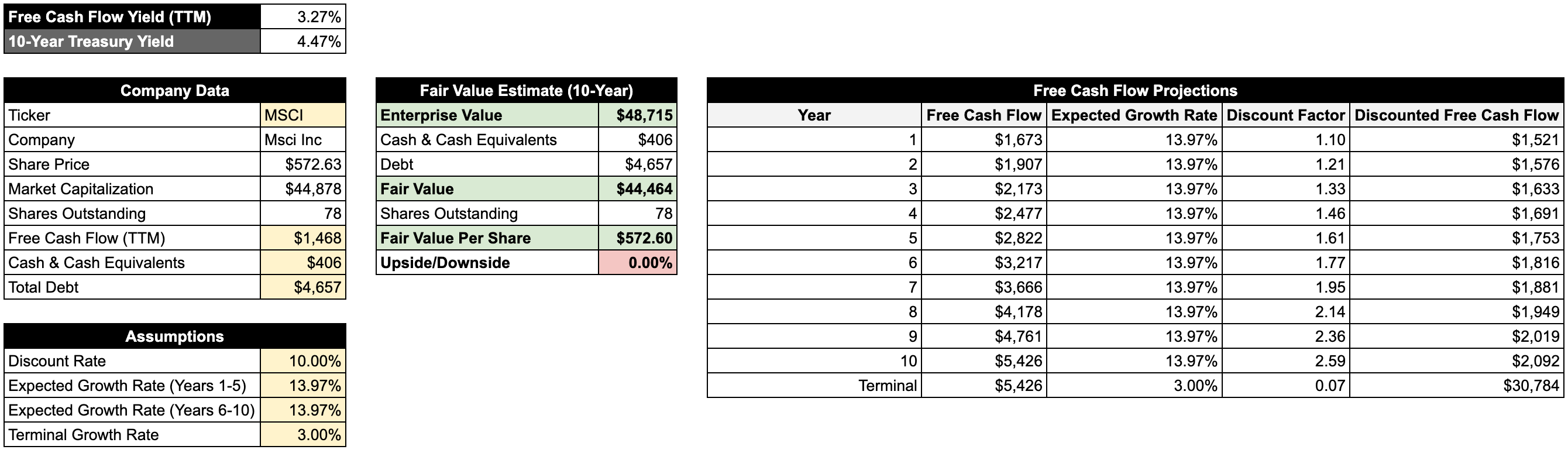
MSCI currently trades at a free cash flow yield of 3.27%, which isn’t terribly expensive for such a high-quality company. For context, the 10-Year Treasury yield, which is often used as the risk-free rate, currently stands at 4.47%.
A more detailed valuation analysis of MSCI (including five and ten year reverse DCF models, an earnings growth model, and buy targets) can be found here.
Conclusion
MSCI is a high-quality business due to its predictable, recurring revenue model, strong pricing power, and dominant position in the financial data industry. With over 90% of its revenue coming from subscription-based services and licensing fees, MSCI benefits from a highly resilient and scalable business structure. Its proprietary indices, risk analytics, and ESG solutions serve as essential tools for institutional investors, creating a strong competitive moat. Additionally, the company's ability to raise prices without significant customer attrition demonstrates its pricing power, while its expansion into ESG and private market analytics provides compelling long-term growth opportunities. With high margins, durable competitive advantages, and efficient capital allocation, MSCI stands out as a high-quality, cash-generating business well-positioned for sustained growth.
Investors seeking a high-quality company that’s been endorsed by top-notch institutional investors should consider MSCI for their portfolios.
Great, high quality company, basically in a genteel duopoly with SPGI; they seem to stay in their respective lanes quite well. I need to do some more work on my valuation model to see how close we are to a buying opportunity amidst the recent sell-off.