
What is Capital Allocation? The Skill That Separates Great CEOs from Average Ones
A practical framework for grading the most underweighted variable in long-term equity returns — and a few companies that get it right.
Two companies in the same industry, with identical revenue growth, identical operating margins, and identical competitive moats, can produce shareholder returns that diverge by more than a thousand basis points cumulatively over a decade. Nothing about their products explains the gap. Nothing about their day-to-day operations explains it either. The difference, almost without exception, is capital allocation — what the chief executive does with the cash the business generates after the bills are paid.
Consider AOL Time Warner. The merger announced on January 10, 2000 was, at the time, the largest corporate transaction in history at $165 billion in stock. The operating businesses underneath were not catastrophic — Time Warner’s cable, content, and magazines continued to generate cash, and AOL still had 30 million paying subscribers. But the combined company posted a $98.7 billion annual loss in 2002 — one of the largest in U.S. corporate history — and over $200 billion of shareholder value evaporated within three years. AOL’s operations did not destroy that value. A single capital allocation decision — using a wildly overvalued internet stock as currency to buy a mature media business — destroyed it.
Capital allocation is the most underappreciated determinant of long-term equity returns. It is the variable that separates 15% compounders from 8% compounders at identical levels of business quality, and the variable most investors spend the least time analyzing — because it operates below the income statement, in the cash flow statement and balance sheet, and resists the kind of quarterly storytelling that dominates sell-side research.
Yesterday’s deep-dive into Brookfield Corporation is a study in exceptional capital allocation over three decades. This piece provides the framework to evaluate it — and every other business in a long-term portfolio.

Section 1
What Capital Allocation Actually Is
Capital allocation is the process by which a chief executive decides what to do with the cash the business generates. Every dollar of free cash flow faces the same set of choices:
Reinvest in the existing business.
Make acquisitions.
Pay down debt.
Pay dividends.
Buy back shares.
The combination of these decisions, made over years and decades, determines whether a business creates or destroys value for the people who own it.
The reason capital allocation is underappreciated is structural. Most investors focus on the income statement — revenue growth, operating margins, earnings per share. Capital allocation operates one layer down, in the cash flow statement and the balance sheet. A business can grow revenue and reported earnings for years while quietly destroying shareholder value, provided the returns earned on each new dollar of deployed capital sit below the cost of that capital. The single best metric for judging this is return on invested capital, or ROIC — the cash a business produces in a year divided by the total capital tied up in producing it. A business earning 25% ROIC against an 8% cost of capital creates value with every retained dollar; a business earning 6% on the same cost of capital destroys it, regardless of what the income statement says.

Section 2
The Five Uses of Capital — and When Each One Creates Value
Every dollar of free cash flow has five possible destinations. The discipline lies in understanding the conditions under which each one creates value, and the conditions under which each one destroys it.
1 — Highest-Return Use
Reinvestment in the Existing Business
Reinvesting cash back into the operating business — new stores, new factories, new products, new geographies — is the highest-returning use of capital available to a chief executive, provided two conditions hold. ROIC on the reinvested capital must exceed the cost of capital by a meaningful margin, and the business must have runway to keep deploying capital at those rates. The intrinsic value growth rate of a business is, in essence, the reinvestment rate multiplied by ROIC. A company that reinvests 60% of earnings at a 25% ROIC compounds intrinsic value at 15% per year before any external capital is deployed.
Reinvestment creates value when ROIC is durable and the runway is long. It destroys value when growth becomes the goal in itself — when capital is deployed at sub-cost-of-capital returns simply to keep revenue or unit count expanding. Many of the worst capital allocation decisions in public markets share this structure: a chief executive who treats growth as the metric, rather than the returns on the capital required to produce it.
Constellation Software has deployed capital at extraordinary rates for over two decades. Founder Mark Leonard explicitly designed the company’s compensation system around ROIC. Operators inside the group are penalised when their acquisitions deliver low returns and rewarded when they earn high ones. The result has been a multi-decade record of more than 1,000 acquisitions made at disciplined multiples, integrated lightly, and held permanently.
2 — Most Common, Most Dangerous
Acquisitions
Acquisitions are the most common capital allocation decision a chief executive will make, and the most frequently value-destructive. Multiple academic studies, including a widely cited Harvard Business Review review of decades of research, conclude that 70% to 90% of mergers fail to create value for acquirers: more often than not, acquirers pay strategic premiums, overestimate synergies, and earn returns below the cost of capital on the price they paid.
Acquisitions create value when three conditions hold simultaneously. The price paid must be below the intrinsic value of what is being purchased. The acquirer must have a genuine operating advantage that allows it to extract more from the asset than the seller could. And the integration costs — both cash and cultural — must be containable. Acquisitions destroy value when the chief executive treats them as a substitute for organic growth discipline, when synergy assumptions become circular justifications for high prices, or when stock is used as currency at inflated valuations.
Danaher is the reference case for disciplined serial acquisition. The company has executed a sustained programme of major deals — Beckman Coulter for $8.8 billion in 2011, Pall Corporation for $13.6 billion in 2015, Cepheid for roughly $4 billion in 2016, Cytiva (the GE Life Sciences biopharma business) for $21.4 billion in 2020, Abcam for approximately $5.7 billion in 2024, and Masimo for $9.9 billion completed in February 2026 — applying a defined operating system, the Danaher Business System, to extract margin and cash flow improvements from each acquired business. Reported GAAP ROIC at Danaher screens in the mid-teens, depressed by the goodwill and intangibles created when premium prices are paid for high-quality assets; the underlying operational return on the businesses themselves, measured by the cash they generate after integration, is materially higher.
The contrasting case is the AOL–Time Warner merger described in the opening. AOL paid $165 billion in stock for Time Warner at a moment when its own market value was over $200 billion against an underlying business about to be made structurally obsolete by broadband. The 2002 goodwill write-down of nearly $99 billion was the eventual accounting recognition of a value-destruction event that had occurred the moment the deal was announced.
3 — The Most Misunderstood Tool
Share Buybacks
Share buybacks are the most misunderstood capital allocation tool. They are neither inherently good nor inherently bad. A buyback is, in effect, an investment in the business itself — and like every other investment, the return depends entirely on the price paid.
Buybacks create value when shares are purchased at a meaningful discount to intrinsic value. The remaining shareholders end up owning a larger fraction of a business they already understand, at a known cost of capital. They destroy value when shares are purchased at or above intrinsic value — the chief executive is overpaying for the company’s own stock, often using cash that could have been deployed at higher returns elsewhere or, worse, leveraging up the balance sheet to do so.
Brookfield Corporation has historically bought back BN shares at material discounts to its sum-of-parts intrinsic value, taking advantage of periods when the public market price diverged from the underlying value of the asset management franchise, the insurance assets, and the direct investment portfolio. In 2025 alone, Brookfield repurchased over $1 billion of its own shares as part of the same disciplined approach. The opposite pattern — mechanical programs executed regardless of share price, often near cyclical highs — is widespread and corrosive. A company that authorises a buyback at a $200 share price and continues purchasing as the stock runs to $400 is not allocating capital; it is consuming it.
4 — The Honest Signal
Dividends
The dividend decision is the most honest signal a chief executive can send about the reinvestment opportunity inside the business. Paying a dividend is, at its core, an admission that retained capital cannot be deployed at attractive rates. That admission is appropriate in some businesses and inappropriate in others. Dividends create value when the business has limited reinvestment runway and distributing capital is more efficient than retaining it. They destroy value when they crowd out higher-return reinvestment opportunities, or when they are maintained beyond what underlying earnings can support.
Coca-Cola is a coherent example of a mature business with a defensible dividend policy. The reinvestment runway within carbonated beverages is finite, and the brand and distribution moat does not require large incremental capital to maintain. Returning a substantial portion of earnings to shareholders is the rational outcome. The error case is a growth business — one with ROIC well above its cost of capital and visible reinvestment opportunities — that pays a meaningful dividend instead of compounding the capital internally. The dividend in that situation signals either a lack of opportunities the investor cannot see, or a chief executive prioritising the appearance of capital return over the mathematics of long-term value creation.
5 — The Conservative Choice
Debt Repayment
Debt repayment is the most conservative use of capital and, occasionally, the highest-return one. The decision rests on a simple comparison: the after-tax cost of the debt against the available returns on the alternative uses of the same capital. It creates value when the cost of debt is high relative to reinvestment returns, or when reducing leverage materially removes a business risk the market is penalising. It destroys value when low-cost debt is repaid early at the expense of high-return reinvestment opportunities.
Most quality compounders carry minimal net debt as a structural matter. Their capital allocation discipline means they rarely need leverage to fund growth, and debt repayment is rarely the binding capital allocation question.
Section 3
How to Grade a CEO’s Capital Allocation
Five diagnostic questions, applied honestly to the historical record, are usually sufficient to grade the chief executive who is wielding the toolkit above.
The first is the baseline: what is the ROIC on organic reinvestment? Calculate it explicitly from the financial statements, year by year, over a decade. A chief executive earning 25% on reinvested capital is creating substantial value. One earning 8% against a 12% cost of capital is destroying it, even if revenue grew over the period. Tomorrow’s piece covers the owner earnings method — the primary tool for calculating what a business actually produces for its owners after maintaining its competitive position — and is the natural companion to this calculation.
The second is the acquisition track record. Take every significant acquisition the chief executive has made in the last decade. For each, identify the purchase price, the multiple of earnings or free cash flow paid, and what the acquired business has contributed to group earnings since. The question is whether the acquirer has earned its cost of capital on the price paid. Pattern recognition here is more predictive than management guidance — serial acquirers with poor track records rarely improve, and chief executives who consistently overpay tend to keep overpaying.
The third is whether the chief executive has bought back stock at value-accretive prices. Compare the timing of buyback activity to the share price and to estimates of intrinsic value. Chief executives who accelerate buybacks when the stock trades at discounts to intrinsic value, and slow them when it trades at full or premium valuations, are demonstrating genuine owner-orientation. Chief executives who repurchase shares mechanically — quarter after quarter, regardless of price — are running a payroll function, not allocating capital.
The fourth is whether the dividend policy is consistent with the reinvestment opportunity. A high-growth business paying a large dividend is signalling either that management lacks confidence in future returns or that it is prioritising income-oriented shareholders over long-term compounding. Conversely, a mature business with limited reinvestment runway that hoards cash rather than distributing it is committing the opposite error.
The fifth is the most qualitative but the most diagnostic: what does the chief executive say versus what do they do? The best capital allocators are specific about returns, explicit about their opportunity cost framework, and honest when an allocation has not worked out. Vague language — “creating shareholder value,” “strategic fit,” “transformative” — is a warning sign. Specific IRR targets, post-acquisition return assessments, and a willingness to admit a mistake are positive signals. Mark Leonard’s annual shareholder letters at Constellation Software set the standard: explicit ROIC tables, candid discussion of when deal sizes have eroded returns, and clear statements about the relationship between deployable capital and the size of the opportunity set.
Section 4
The Capital Allocation Hall of Fame — What Great Looks Like
A small number of public companies have demonstrated genuine capital allocation skill across multiple cycles.
Brookfield Corporation is the cleanest case of multi-tool capital allocation in public markets. The company has executed sum-of-parts buybacks at meaningful discounts to intrinsic value — including over $1 billion repurchased in 2025 alone — deployed long-duration capital into infrastructure and renewable assets at returns that translate into mid-teens equity returns through the asset management franchise, and scaled the alternative asset business without diluting returns. The Brookfield deep-dive published yesterday walks through the historical record in detail.
Constellation Software is the purest example of disciplined acquisition-based compounding. Founded in 1995, the company has acquired more than 1,000 vertical market software businesses, almost always at single-digit multiples of free cash flow, and held them indefinitely. The ROIC discipline embedded in operator compensation produced returns on invested capital that consistently exceeded 20% for most of the company’s history, with the figure compressing in recent years as the capital base has scaled. The compression is itself a useful signal: management has been honest that maintaining historical returns at much larger deal sizes is harder, and has resisted chasing scale at the expense of return.
Copart demonstrates the quieter version of capital allocation excellence. The salvage auction business reinvests capital primarily into land — physical yard capacity in the markets where it operates — at high returns, supplements with selective share repurchases, and pays no dividend. Management famously paused buybacks for several years through 2025 when the stock traded at premium multiples, then resumed in early fiscal 2026 with over $200 million repurchased in the six months ended January 31, 2026. There is no unnecessary leverage and no complexity. The compounding is a function of doing one thing repeatedly and well — and of declining to deploy capital where returns are not available.

Berkshire Hathaway is the reference case from which the modern discipline of capital allocation effectively descends. Insurance float deployed first into wholly-owned operating businesses and then into a concentrated equity portfolio compounded book value at extraordinary rates over six decades under Warren Buffett, who stepped down as chief executive at the end of 2025 with Greg Abel taking over on January 1, 2026. The model is not replicable for most businesses, but the underlying mental model — capital is fungible, every dollar competes against every other use, and the chief executive’s job is to direct each dollar to its highest-return application — is the foundation of the framework.
The negative case is harder to choose because there are so many candidates. AOL Time Warner sits at one end of the distribution as the largest single-event capital destruction in the public-market catalogue: $165 billion of stock issued for an asset that was promptly written down by nearly $99 billion within two years. The error was not subtle. AOL’s own balance sheet, market value, and competitive position at the moment of the deal would have been sufficient to identify the problem. The decision to proceed was a decision to ignore what a sober capital allocator should have seen.
Section 5
The One Question That Reveals Everything
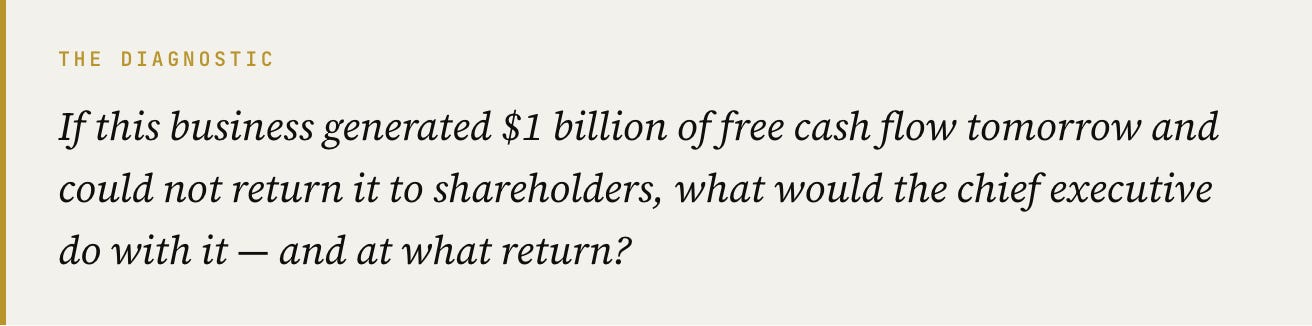
The quality of the answer reveals the quality of the capital allocator. Does the chief executive have a clear opportunity set with explicit return expectations attached to each option? Do they apply a consistent opportunity cost framework, comparing each potential use of capital against the others? Are they honest about the limits of the reinvestment runway, willing to acknowledge when the business has more cash than it can deploy at attractive rates? Or does the answer reach for vague language about acquisitions, dividend policy, and financial engineering without ever mentioning returns on capital?
The best capital allocators answer precisely. The investor’s job is to ask the question — sometimes directly on a call, more often by reading the historical record carefully — and to back the chief executives whose answers are specific, return-focused, and consistent over time.
Capital allocation is the compounding variable most investors underweight. Two businesses with identical operating results, identical moats, and identical growth rates will produce dramatically different outcomes for shareholders over a decade based solely on the quality of capital allocation. This is what separates 15% compounders from 8% compounders at the same level of underlying business quality.
Quality Equities publishes independent research for informational purposes only. Nothing published constitutes investment advice or a recommendation to buy or sell any security. The author may hold positions in securities discussed.
Most investors analyze the business.
Very few analyze what management does after the cash shows up.